IR strobes are handy when you have to locate friendlies in dark environments. As much benefit as they offer in keeping guns off your buddy, they can also be advantageous for the enemy if used carelessly.
For some of you I know that I am just preaching to the choir, but for those of you who constantly run your IR during an operation, listen up! IR strobes are great unless your nemesis also has a pair of NVGs that he is using, in which case you have provided him with your location. Even if your foe doesn't have night vision capabilities, all he needs is a cell phone camera which can also detect IR light.
I've been to many night training venues with other teams, and it's no surprise when the team that runs their strobes constantly gets taken off guard by a hail of sim rounds. This is because the team that role played as the bad guys could see them patrolling in and set up for them.
The solution to this? Just turn the darn thing off when it is not necessary. This way you avoid compromising yourself and your team. If you are in the middle of a firefight, all bets are off and you should follow your team leader's direction. Just don't think that because the IR strobe is on your person that it needs to be turned on. Use it when it can effect mission success.
IR strobes are a great tool when used conservatively. The last thing you want to do in a combat situation is to give up your ability to surprise the enemy and put your team at risk. Use your equipment when necessary and with your head on a swivel.

Showing posts with label night. Show all posts
Showing posts with label night. Show all posts
Sunday, April 29, 2012

Saturday, April 28, 2012
Dual NVGs Vs. Mono NVGs
There's no doubt that the ability to function in the dark is key to combat success. The more we are able to turn the darkness into our ally, the more of a threat we become to the enemy. Therefore, utilizing helmet mounted NVGs (Night Vision Goggles) is vital to mission success. There are two main options you have to consider dual for both eyes or mono for one. Both work excellent for their purpose, but one is not entirely better than the other. It all comes down to necessity for the mission.
Dual NVGs:
 Pros
These are the most common NVGs on the market today, and for good reason. Mono NVGs are the most versatile night optics a modern day warrior can own. The most popular of these is the PVS-14, which is used primarily by the military and law enforcement. Unlike the it's bigger brother, the duals, the mono only covers one eye, usually the non aiming eye. While this can cause some users eye stress by having to focus on one eye, it does leave the eye not being covered ready to negotiate the dark should the NVGs malfunction. This also makes your optic readily accessible with the monos up or down or you prefer not to use an IR laser. Should you have to adjust focus, a simple turn on the ring around the lens is all you need to do. Another benefit to the mono is that they take up considerably less room and can be easily stored in your ruck sack. The problem that I have had with monos is that scanning your surrounding area takes longer since you are looking through a narrower field of view and the clarity may also suffer. Since preferences vary drastically, the mono is a good choice of NVG as there are various different mounts to choose from and other forms of utilization such as a weapon mount if your optic has an IR setting.
The mission will always dictate the proper gear needed for success, but if you are debating between dual and mono NVGs, it is important to know the benefits of each. This way you will be making an informed decision on what to carry into the field. The most important question to consider is "Will this turn the darkness into the best ally that it can be?" Consider this when making your selection and you will be much more successful in your night time operations. Best of luck!
Dual NVGs:
This is an excellent choice for when you expect to be operating in the dark for an extended period of time because the eye relief is excellent unlike the mono's. Combine this with a weapon mounted IR laser and you become deadly on the battlefield. Dual NVGs allow the user to quickly scan, acquire targets, and handle them accordingly without having to stress one eye to do all the seeing. The drawback to the dual NVGs, however, is that they cover both eyes. While this as an excellent feature, it can also be its greatest error to the user in contingency situations. For example, if the dual NVG's go down, you are forced to use your flashlight and give away your position, or wait for your eyes to adjust which takes approximately 20 minutes. Another drawback is that should you have to use your weapon's optic because your laser went down or you never had one to begin with, your ability to see your target is lost as your eyes have not been able to adjust. Also, I would strongly recommend counter weight for the back of your helmet as these are heavier than the monos.
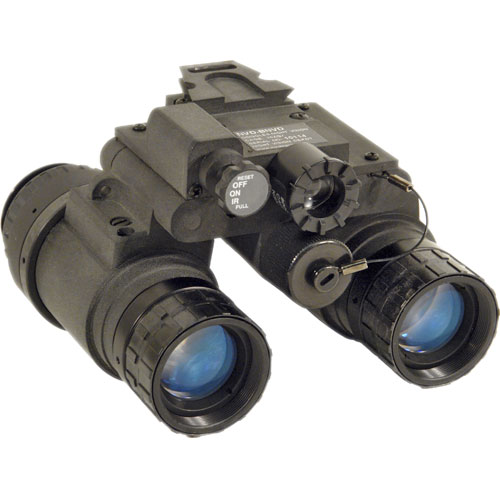
- Excellent eye relief
- Perfect for long night operations
- Feel more natural to the user
- Works well with weapon's IR laser
Cons
- Eyes will have to adjust to dark should NVG's malfunction
- Heavier
- Renders weapon optics useless
Mono NVGs:
Pros
- Highly versatile
- Only disrupts on eye's night seeing ability
- Easily stored
- Multiple gear options
- Leaves weapon optic as an option

Cons
- Slightly more eye strain
- Narrower field of view
- Clarity issues
Subscribe to:
Posts (Atom)